
Double300 & Double500 & Double700
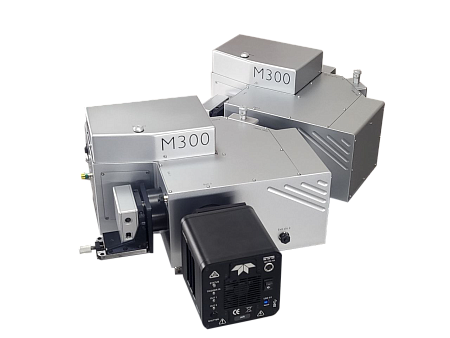
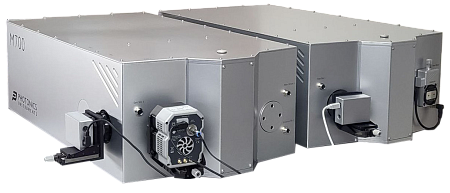

The relevance of double and triple monochromators stems from the requirements of high-resolution spectroscopy and the need to suppress stray light when registrating weak signals. The effective focal length of a double system equals twice the focal length of a single monochromator. The additional suppression of stray light when using double systems with an intermediate slit reaches several orders of magnitude.
A double monochromator-spectrograph is a system of two sequentially adjusted single monochromators-spectrographs operating in an additive dispersion mode, where the exit slit of the first monochromator serves as the entrance slit for the second. Each of the monochromators is constructed according to an optimized Czerny-Turner configuration and contains four diffraction gratings mounted on an automated turret.
The DoubleM300 system has two working exit ports on the second monochromator and one additional side exit port on the first monochromator.
The DoubleM500 and DoubleM700 systems contain three working exit ports on the second monochromator and one additional port on the first.
The additional port of the first monochromator has a flat field of 30x10mm. Typically, a multi-element detector is installed at this port, which is used for recording review spectra with lower spectral resolution, as well as for performing calibration corrections.
Considering the maximum intermediate slit width of 5mm and the horizontal magnification of the optical schemes, the width of the flat field at the exit ports depends on the specific system and averages approximately 6mm. This allows for the use of both PMTs and multi-element image sensors at the exit.
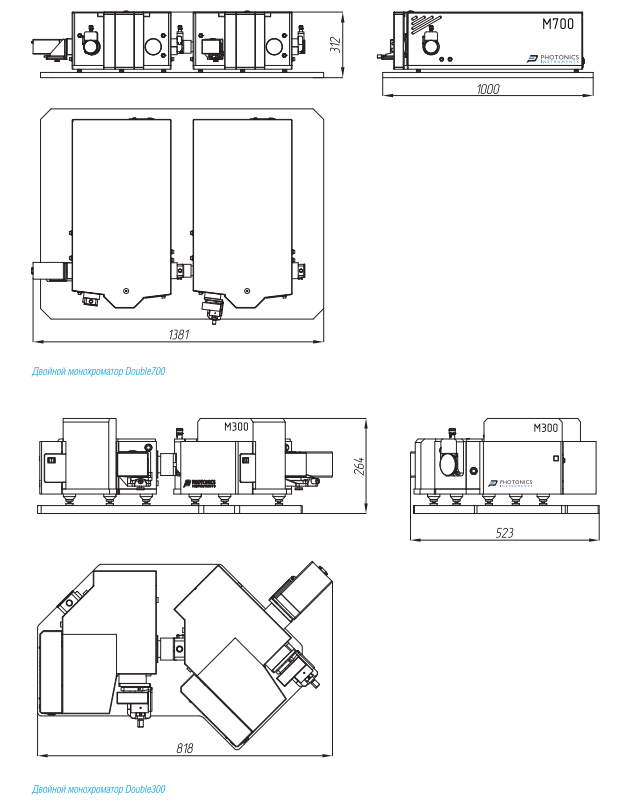
In double and triple systems, thorough factory alignment and calibration are particularly crucial. To achieve the effect of double or triple narrowing of the apparatus function during optical system adjustment, all elements must be perfectly aligned, and the system must demonstrate long-term stability. Therefore, double systems manufactured by Photonics Instruments Ltd are supplied on a mounting plate. The systems are aligned and calibrated by the manufacturer and do not require additional calibration during installation/startup at the User's site.
All systems are fully automated, including control of scanning and diffraction grating changes, adjustment of spectral slit widths, switching of exit ports, control of order-sorting filters, and shutters for recording dark signals. The required set of exit slits and radiation detectors is agreed upon at the order placement stage.
Specification *
|
|
Double300 |
Double500 |
Double700 |
|
Optical scheme |
Optimized Czerny-Turner with one input and two outputs |
Optimized Czerny-Turner with two inputs and three outputs |
Optimized Czerny-Turner with two inputs and three outputs |
|
Spectral range |
190 – 12 000 nm (depends on the chosen diffraction gratings) |
||
|
Aperture ratio |
1 : 3.8 |
1 : 6.5 |
1 :9.1 |
|
Effective focal length, mm |
600 |
1000 |
1500 |
|
Input/output ports |
1 input, 2 outputs |
2 inputs, 3 outputs |
2 inputs, 3 outputs |
|
Imaging (astigmatism compensation) |
Option, available for the output ports |
||
|
Diffraction gratings |
1200 l/mm, blazed at 400 nm |
||
|
– mechanical range, nm |
0 – 1350 |
0 – 1200 |
0 – 1400 |
|
– reciprocal linear dispersion, nm/mm |
1.5 |
0.75 |
0.5 |
|
– spectral resolution (for detector with 7um pixel size), nm |
0.05 |
0.025 |
0.017 |
|
Flat field in the focal plane, mm |
6 x 10 |
||
|
Flate field in the output port of the first monochromator, mm |
30 x 10 |
||
*The specification contains parameters for one diffraction grating of 1200 lines/mm for ease of system comparison. To clarify the specifications for systems with any other gratings, please contact our specialists..